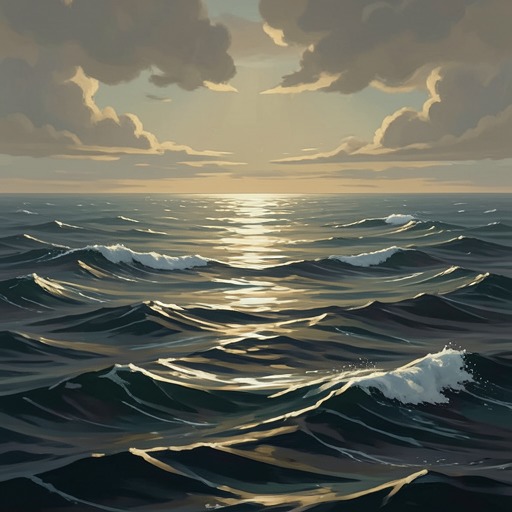
We perished, each alone
To the Lighthouse“We perished, each alone” is a recurring phrase in the Lighthouse journey that gives voice to the novel’s tension between human solitude and the desire for connection. First spoken aloud by Mr Ramsay, it returns in Cam’s thoughts and Lily Briscoe’s murmur, then reappears as an unspoken possibility in Mr Ramsay’s mind near the Lighthouse. Its repetition links the travelers, but the distinct circumstances of each return keep their inner lives separate.
First Utterance and Its Setting
In the boat, as the breeze freshens and the water breaks into green cascades and foam, Mr Ramsay says, “We perished,” and then, “each alone.” He pulls himself up with a gesture toward shore, as if checking or retreating from the mournful force of the words. The phrase enters a scene marked by movement and change: the boat draws away from the island, and Cam finds the familiar house difficult to distinguish from the distant hillside.
Mr Ramsay’s line does not simply describe the sea journey. His gaze toward the receding house calls up an image of himself alone on its terrace, bowed and bereaved, while he imagines the sympathy women might offer him. The phrase is thus set beside his private drama of loss and his desire for consolation. Its stark insistence on being alone contrasts with the sympathy he imagines receiving, without making that imagined comfort equivalent to genuine access to another person’s experience.
Cam’s Repetition and the Changing Shore
Cam hears the words as her father’s melancholy verse, and the sound shocks and outrages her. When Mr Ramsay breaks off to point out the island, she cannot see what he wants her to see. For her, the paths and lawn are already rubbed out, belonging to a past that seems unreal beside the immediate particulars of the boat: its patched sail, Macalister’s earrings, and the noise of the waves. She murmurs the phrase because it has broken repeatedly into her mind, joining the loss of the old home to the solitude it names.
The phrase also falls within the siblings’ strained compact to resist their father’s authority. Cam feels that Mr Ramsay has imposed his wishes on them and spoilt the pleasure of the morning; James steers grimly and fears Cam will yield, leaving him alone to uphold their resistance. As the boat moves faster, however, Cam’s bond with James slackens, and both briefly feel escape and exhilaration. The words do not erase these shifting allegiances: they sound against a journey in which shared grievance, sibling attachment, and individual perception continually pull apart.
Distance and Lily’s Perspective
Later, from the lawn, Lily looks out toward the island as it loses its sharpness and becomes small and distant. The sea increasingly occupies her attention: waves rise and sink around a drifting log and a gull, and she imagines a ship having sunk somewhere nearby. Half asleep, she murmurs, “how we perished, each alone.” Her version of the phrase emerges not from the same position as Mr Ramsay’s speech or Cam’s distress, but from her contemplation of the sea and the diminishing shore.
Lily’s perception makes distance itself the hinge of the episode. As Mr Ramsay and the children recede across the bay, her feeling toward him changes; he seems elongated and remote, as though swallowed by the blue. The phrase consequently gathers more than one kind of separation: the physical distance between boat and lawn, the mental distance between observers, and the solitude each person inhabits even while sharing a scene.
Return at the Lighthouse
Near the end of the crossing, two men on the Lighthouse watch the boat and prepare to receive it. Mr Ramsay sits ready to land with Nancy’s large, badly packed brown-paper parcel on his knee, staring back at the island. Cam and James cannot tell what he is thinking. They imagine asking what he wants and offering him anything, but he asks them for nothing; the narration leaves open whether he is thinking, “We perished, each alone,” or instead that he has reached and found his destination.
That unresolved alternative is central to the phrase’s force. It can accompany bereavement and separation, but the arrival at the Lighthouse also gives the journey a completion that the words themselves do not explain away. Mr Ramsay puts on his hat, tells the children to bring the parcels for the Lighthouse men, and springs onto the rock, standing straight and tall. The repeated line remains suspended between solitude and arrival: it connects the journey’s separate consciousnesses without claiming that they have become one.